The narrative dominating tech circles today tells a familiar story: AI is eliminating tech jobs, the tech hiring market has crashed, and we are heading toward a talent apocalypse. We have spent the past 18 months closely analyzing the tech labor market. What we are seeing contradicts almost everything being discussed on LinkedIn and in tech media.
The reality is far more nuanced and, frankly, more interesting than the doom-and-gloom headlines suggest. We are not witnessing a collapse, but rather are experiencing a market correction that’s creating unprecedented opportunities for those who understand what’s actually happening.
Tech Hiring Market in 2026: The Real Data Behind the Headlines
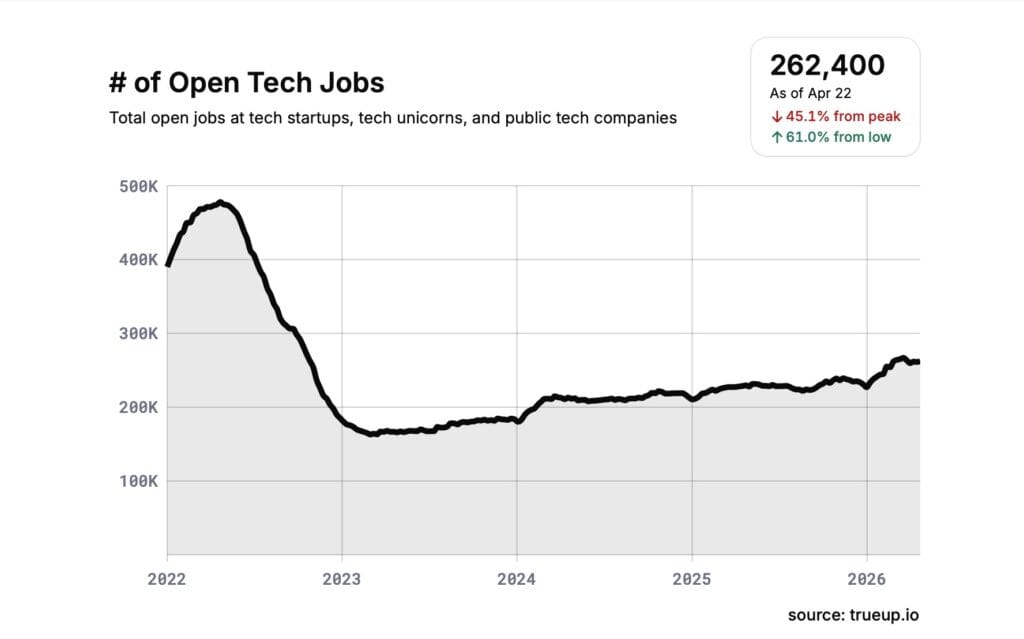
While social media amplifies stories of layoffs and hiring freezes, the actual data tells a different story. The United States currently has 61% more tech job openings than at the 2023 trough. Poland and broader Europe are also experiencing growth in tech job postings. These aren’t the metrics of a dying market, but the signs of a fundamental reset.
This reset, however, isn’t uniform. The tech hiring market has stratified into three distinct tiers, each experiencing dramatically different conditions. Understanding these tiers is essential for both tech professionals planning their careers and companies building their hiring strategies.
Tier 1: The Commodity Layer – A Necessary Contraction
The first tier represents what we call the commodity layer, and yes, it’s shrinking. This segment includes junior developers, recent bootcamp graduates, and generic “full-stack developers” without deep specialization. During the COVID-era hiring frenzy, companies hired many people with basic coding knowledge, often paying $/€60,000-80,000 for roles that primarily involved closing Jira tickets.
That era has ended, but not for the reasons most people assume. AI didn’t eliminate these positions, the artificial demand simply evaporated. Companies are now asking fundamental questions: “Do we need six people doing this work, or do we need one or two people who genuinely understand the system?” The answer is consistently the latter.
This contraction is painful but necessary. The market overcorrected during the pandemic, creating unsustainable hiring patterns that had to normalize. Junior developers entering the market today face higher barriers to entry, but those who clear these hurdles are entering more sustainable, realistic employment situations.
Tier 2: The Execution Layer – Stable but Stagnant
The middle tier consists of mid-level and early senior engineers with 2-5 years of genuine experience. These professionals can take ownership of projects, work with ambiguity, and ship products without constant supervision. This segment remains stable but faces unique challenges.
Demand exists, but growth has stalled. The pipeline problem is real: companies that froze junior hiring two years ago now have no one to promote. Mid-level engineers aren’t experiencing layoffs, but they’re also not advancing to senior roles at expected rates and pace. Why? Because senior positions now demand capabilities that weren’t required three-four years ago, on top of technical skillset, it is AI literacy, system design at scale, and cross-functional leadership.
This creates a frustrating stagnation for talented mid-level engineers who find themselves caught between vanishing entry-level positions below them and increasingly demanding senior roles above them. The career ladder they expected to climb has fundamentally changed shape.
Tier 3: The Architect Layer – Where the Real Shortage Lives
The strong senior and architect tier is experiencing growing demand. This isn’t about developers with 5-8+ years of experience, plenty of those exist. The shortage is in professionals who can actually perform senior-level work in today’s market.
At Itentio IT Recruitment, we’re seeing companies offer $/€80-120,000+ for these roles and still struggle to fill them. The skillset required has evolved dramatically. Today’s senior engineers must know when AI-generated code is wrong, architect systems for scale rather than just functionality, lead teams without extensive junior benches to delegate to, and make architectural decisions that won’t create disasters 6-12-18 months down the line.
This tier represents where the tech hiring market is truly competitive. Companies are willing to pay premium rates for professionals who can deliver at this level, but finding candidates who meet these elevated standards remains challenging.
Three Critical Predictions for the Tech Hiring Market
Based on recruitment data and market trends we’re tracking at Itentio IT Recruitment, three major shifts are coming that will reshape tech hiring:
The Junior Pipeline Crisis of 2027-2028
Companies that froze junior hiring between 2023-2025 are creating a time bomb. By 2027, they won’t have mid-level engineers because they stopped developing that talent pipeline. When they attempt to hire their way out of this gap, they’ll discover the talent simply doesn’t exist in the market.
This will trigger salary spikes for experienced senior engineers as companies compete for a limited pool. Organizations that maintained their junior hiring and training programs during this period will possess a competitive advantage. The short-term cost savings from cutting junior positions will prove enormously expensive in the medium term.
The End of Full-Stack Generalism
The viable career paths in tech are bifurcating into two distinct tracks: specialists with deep expertise in specific domains, and strong seniors to architects with broad understanding combined with strong decision-making ability. The middle ground, developers who “know a bit of everything”, is being squeezed by AI capabilities and offshore talent.
This doesn’t mean full-stack knowledge is worthless, but it means being a generalist alone is no longer sufficient. You need to be either a specialist who happens to have full-stack capabilities, or a solution architect who uses that breadth to make strategic decisions. Pure generalism as a career strategy is becoming untenable.
Geographic Arbitrage is Reversing
For years, Eastern Europe and India competed primarily on cost advantages. That dynamic is fundamentally changing. US companies are realizing that hiring a genuinely senior engineer in Poland for $/€80-120,000 who delivers exceptional work is more interesting budget-wise to hiring someone in California for around $200,000 with the similar talent quality.
The advantage is no longer cheaper labor, it’s quality per dollar. Countries and regions that can produce genuinely skilled engineers will thrive. Those that competed purely on volume will lose ground to AI automation and even cheaper emerging markets. This shift favors Poland, parts of Eastern Europe, and select regions that have invested in actual technical education rather than just coding bootcamps.
Tech Hiring Market in 2026: Strategic Guidance for Companies and Hiring Managers
The cheap talent pool has evaporated. The “hire fast, fire fast” approach that worked during the pandemic hiring boom is no longer viable. If you want senior engineers available in 2028, you need to invest in junior developers now, not in 2027 when you discover your pipeline gap.
Strategic tech hiring in 2026 means:
- Investing in junior talent development programs even when it feels expensive, because the alternative is a talent drought in a couple of years.
- Creating career development frameworks that help mid-level engineers transition to senior roles, rather than assuming they’ll figure it out independently.
- Building relationships with specialized tech recruitment partners who understand these market dynamics and can help you navigate the stratified talent landscape effectively.
The Bottom Line: A Stratified Tech Hiring Market, Not a Dying One
We’re not heading into a tech apocalypse. The fundamental question isn’t “Will tech jobs exist in 2030?” The question is: “Will you be the kind of engineer companies compete for, or the kind they’re trying to automate away?”
For tech professionals, this market is providing clear signals right now. The companies hiring, the roles they’re filling, and the compensation they’re offering all point toward what the market values.
For companies, the message is equally clear: strategic talent investment today determines your competitive position tomorrow. The organizations that understand this are building sustainable advantages. Those treating hiring as a purely tactical, cost-focused exercise are creating future crises.
Working with Itentio IT Recruitment
At Itentio IT Recruitment, we specialize in navigating complex, stratified tech hiring market across Poland and the EU. We understand the difference between developers with senior titles and professionals who can actually deliver senior-level work. Whether you’re a company building or expanding your tech team or a skilled professional seeking your next opportunity, we focus on quality matches that create long-term success.